James Wallace Black
1825–1896 · United States
From mountain scenery to the city seen from the sky.
Explore 2 works ↓Life and work ↓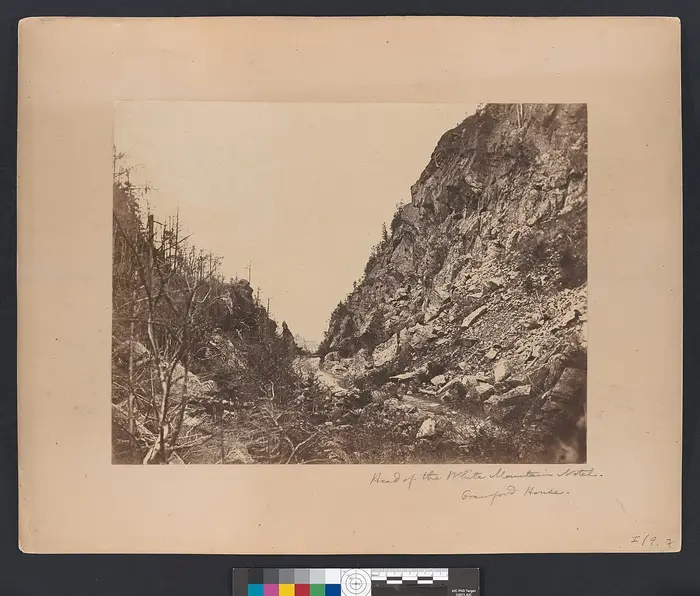
James Wallace Black · 1854
The Metropolitan Museum of Art · Robert O. Dougan Collection, Gift of Warner Communications Inc., 1981
CC0 — domaine public · Reuse conditions · Artwork record
A journey through images.
Explore the selection at your own pace. Click a photograph to enlarge it, then move from one work to the next.
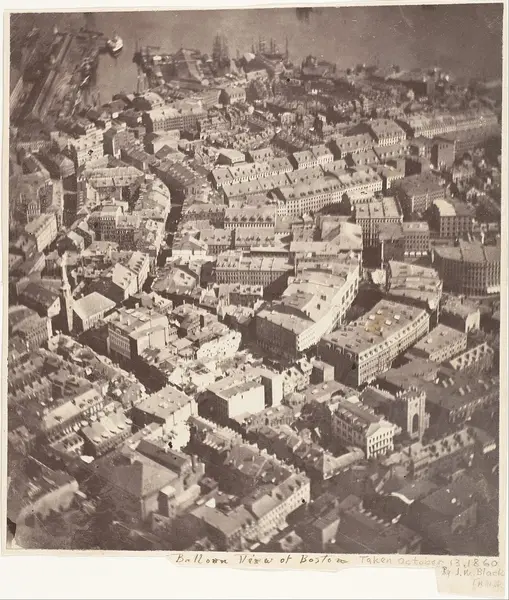
James Wallace Black · 1860
The Metropolitan Museum of Art · Gilman Collection, Purchase, Ann Tenenbaum and Thomas H. Lee Gift, 2005
CC0 — domaine public · Reuse conditions · Artwork record
Each photograph links to its portfolio or collection record. Titles, dates and credits are retained when supplied by the source.
The story
James Wallace Black was an American photographer whose career was marked by experimentation. His view of Boston taken in 1860 is a major reference in the history of aerial photography. Comparing it with a White Mountains landscape shows how height and distance change the description of a territory. The camera becomes a means of accessing unusual viewpoints.
The selection preserved at the Metropolitan Museum of Art allows two works to be examined: Head of the White Mountain Notch, Crawford House, Boston, as the Eagle and the Wild Goose See It. The records identify the following techniques: Albumen silver print from paper negative; Albumen silver print from glass negative. This information distinguishes the moment of exposure, the process and the preserved object.
Understanding the work
In the landscape, slope and path construct depth. In Boston, streets become a graphic network and buildings closely grouped volumes: the change in height produces another reading of the city.
Key works and series
Head of the White Mountain Notch, Crawford House (1854) ; Boston, as the Eagle and the Wild Goose See It (1860). The museum records specify each print’s process, dimensions, provenance and accession number.