George Wilson Bridges
United Kingdom
Mediterranean travel through early paper negatives.
Explore 2 works ↓Life and work ↓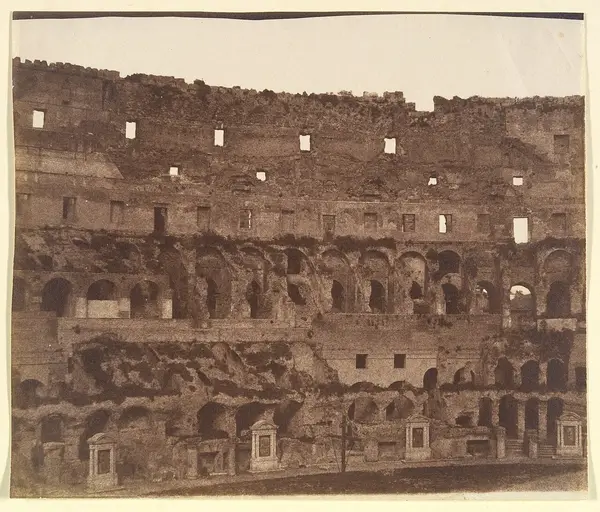
George Wilson Bridges · 1850s
The Metropolitan Museum of Art · David Hunter McAlpin Fund, 1946
CC0 — domaine public · Reuse conditions · Artwork record
A journey through images.
Explore the selection at your own pace. Click a photograph to enlarge it, then move from one work to the next.
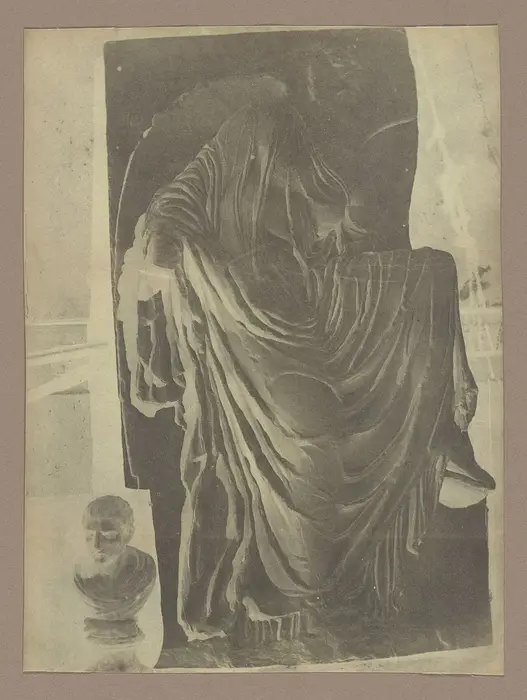
George Wilson Bridges · 1848
The Metropolitan Museum of Art · The Rubel Collection, Purchase, Lila Acheson Wallace and Anonymous Gifts, 1997
CC0 — domaine public · Reuse conditions · Artwork record
Each photograph links to its portfolio or collection record. Titles, dates and credits are retained when supplied by the source.
The story
A British clergyman and photographer, George Wilson Bridges travelled around the Mediterranean with a camera. His work brings together monuments, sculptures and sites, at a time when images on paper were renewing the practices of travel. The views of Rome and an ancient relief demonstrate this movement from an entire place to a fragment. They also show the softness of detail characteristic of early paper prints.
The selection preserved at the Metropolitan Museum of Art allows two works to be examined: [Colosseum, Rome], Basso Relievo--of Wingless Victory--lately found. The records identify the following techniques: Salted paper print from paper negative; Paper negative. This information distinguishes the moment of exposure, the process and the preserved object.
Understanding the work
Compare the thickness of the Colosseum’s walls with that of the folds in the relief. In both cases, light makes depth perceptible, even when the image seems almost monochrome.
Key works and series
[Colosseum, Rome] (1850s) ; Basso Relievo--of Wingless Victory--lately found (1848). The museum records specify each print’s process, dimensions, provenance and accession number.